Table of contents
It feels instant: click, confirm, done. Yet behind every “order placed” screen sits a chain of software, warehouses, payments, fraud checks and last mile logistics that has grown more complex as shoppers demand faster delivery, tighter tracking and painless returns. In 2024, global e-commerce sales were estimated in the trillions of dollars, and the share of shoppers buying across borders kept rising, forcing retailers to make split-second decisions about taxes, inventory and risk. The real story is not the button, it is the orchestration that happens in milliseconds, and sometimes, in the messy hours that follow.
The invisible seconds after you click
What happens in those first 500 milliseconds? The moment a customer confirms an order, modern commerce platforms begin a rapid handshake between systems that often belong to different companies, run on different clouds and speak different “languages” of data, and the goal is simple: say “yes” only when the business can truly deliver. A typical order confirmation triggers inventory verification, address validation, tax calculation, shipping promise logic and payment authorization, and if any one of these steps fails, the experience degrades into the dreaded “something went wrong” message.
Inventory is rarely a single number sitting in a single database. Many retailers operate with distributed stock across stores, regional fulfillment centers and third-party logistics partners, and the “available” quantity changes constantly because other shoppers are buying at the same time, because items are being picked on the warehouse floor and because returns are being restocked. That is why “real-time inventory” is often closer to “near real-time,” and why platforms use reservation logic, holding an item for minutes while payment clears, then releasing it if the transaction fails. The growth of omnichannel retail has made this balancing act more delicate: buy online, pick up in store sounds simple, yet it depends on precise stock counts and on staff actually finding the item quickly.
Then comes the promise. Delivery dates shown at checkout are not just marketing; they are a calculation that blends carrier cut-off times, warehouse capacity, distance, local holidays and even weather risk in some advanced models. Miss that promise and the cost is not only a refund or a free upgrade, it is also churn. Studies have repeatedly linked delivery disappointment to cart abandonment, and analysts tracking consumer behavior in the US and Europe have noted that shipping costs and delivery speed remain among the top reasons shoppers leave without buying. The “seamless” experience therefore rests on a constant trade-off between optimism and operational reality, and the most mature systems bias toward what they can execute, not what looks best on a banner.
Payments, fraud and the modern trust gap
Friction is the enemy, but fraud is relentless. Payment is the most sensitive moment in the order flow because it is where customer trust and merchant risk collide, and the industry’s numbers show why merchants are cautious. Global card fraud losses have been measured in the tens of billions of dollars annually in recent years, while friendly fraud, chargebacks and account takeovers have become routine threats for brands of all sizes. That is why the payment step is not a single yes-or-no; it is a layered decision, made under time pressure, with incomplete information.
In practice, payment authorization can involve multiple parties: the customer’s bank, the card network, the payment gateway and the merchant’s own risk engine. Add digital wallets, local payment methods and “buy now, pay later” providers, and the checkout becomes a hub of conditional logic, where the system tries to maximize approval rates without welcoming criminals. Risk scoring often uses device fingerprints, IP reputation, velocity checks, shipping-billing mismatches and behavioral signals, and the most advanced setups run A/B-tested rules to avoid blocking legitimate buyers. The problem is asymmetrical: a fraudster needs only one loophole, while a merchant must prevent loss without turning away a good customer who might never return.
Regulation has also reshaped the flow. In Europe, Strong Customer Authentication under PSD2 pushed more transactions toward 3-D Secure, and that has changed what “smooth” looks like, because an extra step may be required even when the shopper feels everything should be one tap. Meanwhile, the move to tokenization, network tokens and stored credentials has reduced some types of risk, but it has also increased technical complexity. Behind the scenes, merchants monitor approval rates, soft declines and authentication challenges, and small percentage swings can translate into huge revenue differences at scale. A checkout that feels effortless is often the result of years of tuning: fewer false declines, fewer chargebacks and a better balance between speed and certainty.
Fulfillment is where perfection is tested
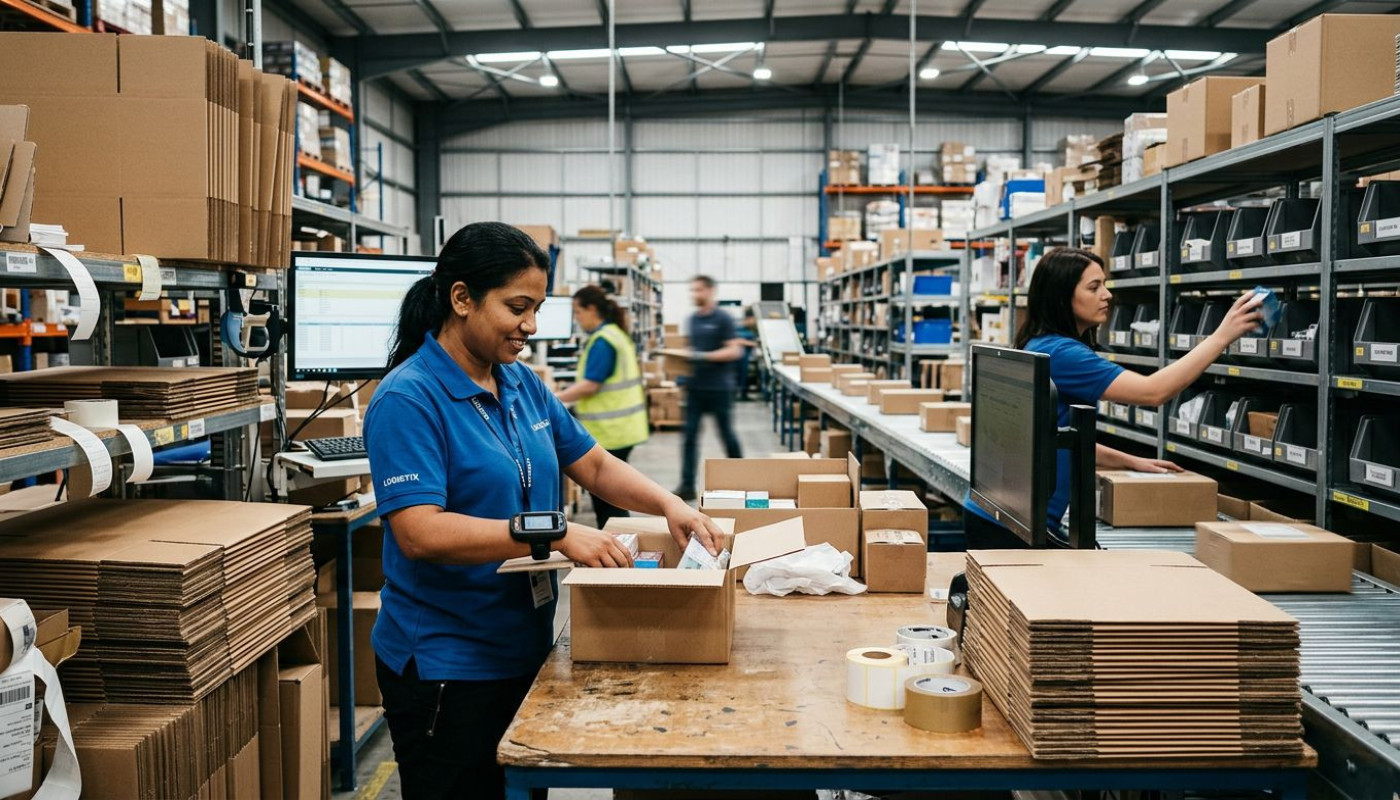
The warehouse never lies. Once payment clears, the order leaves the digital world and enters the physical one, and this is where “seamless” experiences are most likely to crack, because atoms are harder than pixels. Picking errors, stock discrepancies, damaged goods, carrier delays and capacity constraints can all surface after the customer has already been told “confirmed.” Retailers therefore invest heavily in fulfillment orchestration: deciding which node ships the order, in what packaging, with which carrier, and whether the order should be split across multiple locations to meet the promised date.
Costs drive these decisions as much as speed. Shipping is one of the largest variable expenses in e-commerce, and surcharges, dimensional weight pricing and peak-season fees can turn free delivery into a margin killer. That is why many systems run “rate shopping” in real time, comparing carriers and service levels, and choosing the option that meets a promised deadline at the lowest cost. The customer sees a tracking number; the merchant sees an optimization problem. Increasingly, retailers also rely on automation inside warehouses, from conveyor systems to robotic picking in high-volume facilities, because labor remains a constraint in many markets and because same-day expectations compress the timeline from order to dispatch.
Returns add another layer, and they are no longer a niche issue. In apparel, return rates can be high compared with other categories, and even in electronics, consumers expect painless refunds. Reverse logistics is expensive: items must be inspected, repackaged, resold or written off, and each step introduces delay and loss. The best order processes anticipate returns from the start, using packaging choices, accurate product information and fit guidance to reduce unnecessary send-backs, and clear policies to avoid disputes. Seamless ordering, in other words, is inseparable from seamless unwinding, because what matters to customers is not only delivery but the confidence that a mistake will be fixed quickly.
Why “seamless” is built, not bought
There is no single switch for reliability. The most resilient order experiences come from the unglamorous work of systems integration, monitoring and continuous improvement, and that work has accelerated as shoppers spread across apps, marketplaces, social platforms and brand websites. Each new channel adds more points of failure: inventory sync delays, price mismatches, inconsistent promotions, duplicate customer records and refund reconciliation problems. When the process works, it is because the underlying architecture has been designed for change, not because it was perfect on day one.
Observability has become central. Teams track latency, error rates, payment authorization success, carrier scan events, warehouse pick times and customer support tickets, and they correlate those signals to find where friction begins. A spike in “address not found” errors might point to a third-party validation outage; a drop in approvals might signal an issuer change; a rise in “where is my order” contacts might reflect a carrier backlog. The best operators build runbooks, automate alerts and rehearse incident response, because outages are not hypothetical. Even short disruptions can have outsized consequences during peak events, when traffic surges and consumers have little patience for retries.
For companies that need to modernize their ordering stack, the path usually involves choosing what to own and what to outsource, and then ensuring that data flows cleanly between components. That can mean upgrading the commerce platform, consolidating product and inventory data, strengthening fraud tooling, improving carrier integrations and redesigning post-purchase communication. Readers who want to explore how service providers structure and support that kind of operational backbone can visit their website, and compare approaches around integration, monitoring and customer experience outcomes. The key is not a buzzword; it is whether the system keeps its promises when conditions are messy, because that is when customers decide if a brand is trustworthy.
Before you hit “buy” again
Check the practical details that shape the experience: delivery windows, return conditions and customer support access, and if you are buying high-value goods, consider payment protections and warranty terms. For businesses, budgeting should include not only software but also fraud losses, chargeback fees and fulfillment overhead, and in some regions, digitalization grants or logistics support programs may help fund upgrades.
On the same subject